We took a trip today to Cesky Krumlov to check another item off the list of things to see before we leave Prague in a few weeks. The Garmin got us there without an y significant problems (just a little hiccup where a new section of highway was recently completed) and I was even able to bring up the closest parking lot to park in. It was really smooth.
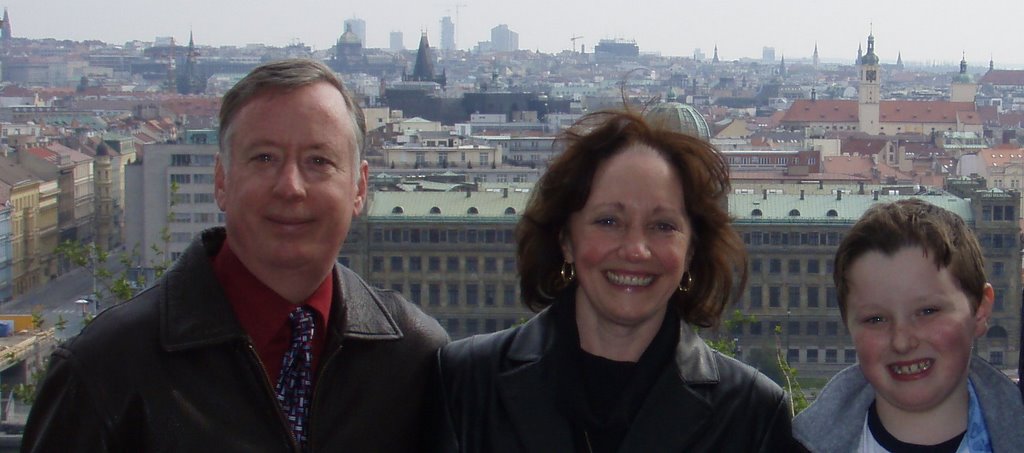
Here we are upon our arrival at Cesky Krumlov. A nice German lady took our picture for us.
Cesky Krumlov is a UNESCO world heritage site and is an amazing place. The Vltava river - the same river that runs through Prague 150 miles to the north - surrounds teh town on three sides. This made the town more easily defended.
From Wikipedia:
Construction of the town and castle began in the late 13th century at a ford in the Vltava River, which was important in trade routes in Bohemia. In 1302 town and castle was owned by the House of Rosenberg. Emperor Rudolf II bought Krumau in 1602 and gave it to his natural son Julius d’Austria. Emperor Ferdinand II gave Krumau to the House of Eggenberg. From 1719 until 1945 the castle belonged to the House of Schwarzenberg. Most of the architecture of the old town and castle dates from the 14th through 17th centuries; the town's structures are mostly in Gothic, Renaissance, and Baroque styles. The core of the old town is within a horseshoe bend of the river, with the old Latrán neighborhood and castle on the other side of the Vltava.
The town became part of the Austrian Empire in 1806 and Austria-Hungary in 1866. 8,662 inhabitants lived in Krumau an der Moldau in 1910, including 7,367 Germans and 1,295 Czechs.
After World War I, Krumau belonged from October 1918 until September 1919 to Upper Austria within the Republic of German Austria. In November 1918 Czech troops occupied the town. During the interwar era it was part of Czechoslovakia. Between 1938 and 1945 it was annexed by Nazi Germany as part of the Sudetenland. The town's German-speaking population was expelled after liberation by the American Army during World War II and it was restored to Czechoslovakia.[1]
During the Communist era of Czechoslovakia, Krumlov fell into disrepair, but since the Velvet Revolution of 1989 much of the town's former beauty has been restored, and it is now a major holiday destination popular with tourists from Germany, Austria, and beyond. In August, 2002, the town suffered from damage in the great flood of the Vltava River.
Český Krumlov Castle is unusually large for a town of Krumlov's size; within the Czech Republic it is second in extent only to the Hradčany castle complex of Prague.
Český Krumlov is home to Pivovar Eggenberg brewery. It has also been used as filming locations for movies such as the 2006 films The Illusionist and Hostel.
Part of the castle complex. In the Czech Republic it is second in size only to Prague castle. We climbed up to the area just below the dome.
Here is a picture from the castle looking back down on the town and the Vltava River.
Riding the river is a popular thing to do in Cesky Krumlov.
Sunday, May 25, 2008
Cesky Krumlov...


Tuesday, May 6, 2008
The assasination of Heydrich...

I have posted in the past about the story of the town of Lidice, just outside of Prague. Reinhard Heydrich, Hitler's Reichsprotekto in Bohemia and Moravia, died on June 4, 1942 from wounds suffered in an attack by Czech partisans who had parachuted into Czechoslovakia after being trained in England. Heydrich's funeral was on June 9, and the following day all of the men of Lidice (173 in all) were executed, the women and children were sent to camps, most of them to perish, and the town itself was raised to the ground to remove all evidence that it had ever exisited. The Nazis even emptied the cemetery of its corpses. This was all to teach a lesson to the Czechs that to fight the Nazis would result in swift and incredibly cruel consequences.
After the attack on Heydrich's car that left him mortally wounded, the seven parachutists ended up at the Church of Saints Cyril and Methodius in Prague which had been arranged as a safe house and they were concealed in the crypt of the church.
With the aid of a turncoat Czech named Karel Curda, the Germans learned of the location of the parachutists and 800 soldiers surrounded the church at 2:00 am on June 18, 1942. The Germans entered the church before dawn but were met by three of the parachutists firing from the choir loft who held the Germans at bay for several hours but were eventually killed. It was discovered that the others were in the crypt and the orders were to take them alive. The Nazis tried pumping smoke and then water into the crypt to force the four remaining parachutists to surrender. Rather than be captured the four committed suicide.
Heydrich's car after the attack on May 27, 1942. He would die from his wounds on June 4.
Bullet holes from the attack on June 18, 1942 remain visible near a small window to the crypt of the church.
Inside the crypt there are many memorials to the men who killed Heydrich.
This small cross is just outside the main door to the church.
The price paid by the church for aiding the parachutists was extremely high. from the web:
The trial of the members of the Czech Orthodox Church was held on September 3, 1942, after which Bp. Gorazd, Fr. Cikl, and council chairman Sonnevend were executed by a firing squad on the next day. Fr. Petrek was executed on September 5. For aiding the parachutists, 263 Czechs were arrested, transported to the Mauthausen concentration camp, and shot to death on October 24, including nine members of the cathedral’s congregation: Marie Ciklova, wife of the dean; Marie Gruzinnova, Bp. Gorazd’s secretary; Marie Sonnevendova, wife of the council chairman; Ludmila Rysova, choir member; Vaclav Ornest, the sacristan, his wife Frantiska Ornestova, and daughter, Miluse Ornestova, a choir and youth group member; Karel Louda, choir member; and Marie Loudova, also a choir and youth group member. In all, the Orthodox Church lost 13 sons and daughters.
Thursday, May 1, 2008
Karlovy Vary...

With our upcoming departure from the Czech Republic we have developed a punch list of things to see before we leave (a short 7 weeks from now). One of these items is to visit Karlovy Vary. Since today is a holiday (May Day) we decided to take the 90 minute drive to Karlovy Vary in the western part of the Czech Republic.
Here is information from Wikipedia:
Karlovy Vary (German: Karlsbad), sometimes known in English as Carlsbad, is a spa city situated in Bohemia, the western part of the Czech Republic, on the confluence of the rivers Ohře (German: Eger) and Teplá. Carlsbad is named after Holy Roman Emperor Charles IV, who founded the city in 1370. It is historically famous for its hot springs (13 main springs, about 300 smaller springs, and the warm-water Teplá River).
In the 19th century, it became a popular tourist destination, especially for international celebrities visiting for spa treatment. The city is also known for the Karlovy Vary International Film Festival and the popular Czech liqueur Karlovarská Becherovka. The glass manufacturer Moser Glass is located in Carlsbad.
The city has been used as the location for a number of film-shoots, including the 2006 films Last Holiday and box-office hit Casino Royale, both of which used the city's Grandhotel Pupp in different guises.
On 14 August 1370, Charles IV, Holy Roman Emperor gave city privileges to the place that subsequently was named after him, according to legend after he had acclaimed the healing power of the hot springs. However, earlier settlements could be found in the outskirts of today's city.
Due to publications by doctors like David Becher and Josef von Löschner, the city developed into a famous spa resort and was visited by many members of European aristocracy. It became popular after the railway lines to Eger (Cheb) and Prague were completed in 1870.
The number of visitors rose from 134 families in the 1756 season to 26,000 guests annually at the end of the 19th century. By 1911 that figure had reached already 71,000 but the Great War put an end to tourism and also led to the collapse of the Austro Hungarian Empire by late 1918.
The German-speaking majority protested against being made a part of Czechoslovakia by the Treaty of Saint Germain. A demonstration on 4 March 1919 passed peacefully, but later that month six demonstrators were killed by Czech troops after a demonstrations turned unruly[1].
In 1938 the Sudetenland including Karlovy Vary became part of German Reich and the entire Czech population was expelled. The German speaking inhabitants thus[citation needed] became a majority in the city until their expulsion in 1945.
Before that, the Carlsbad Decrees of 1819 had associated the city with anti-liberal censorship within the German Confederation.
The center of Karlovy Vary.
May Day in Karlovy Vary.
Noah trying some tree climbing.
Pastel colors and horse drawn carriages.
Kathy samples the mineral waters for which Karlovy Vary are famous. Nearly every tourist walks around with a special glass for the waters. The water itself was hot and with iron or sulphur. Not very good, really.
Just like Petrin in Prague, Karlovy has a hill with a furnicular to the top, and then a tower you can climb for a great view of the area.
It was aa great day for a trip to Karlovy Vary.
Wednesday, April 30, 2008
Kathy and "le Sabrage" (Using a sword to take the top off a bottle of champagne)...
Kathy had what she described as one of her best days in Prague yesterday. She went on one of the "Let's Go" tours with several of her friends from ISP. This one was called "Surprising Spring Walk" and covered some hidden places in Mala Strana including the Palffy Palace (music school) and Royal Gardens.
It also included a stop at the restaurant U Maliru (literally,"At the Painters") which is described on-line as "A landmark restaurant with a history spanning 460 years, appreciated by kings, diplomats and politicians alike. Fine French cuisine among the restored frescoes or in the summer garden with a view of a picturesque little square on the Lesser Side. When the famous gourmet King Rudolf II sent his spies to investigate Czech pubs, a superb kitchen was indicated by one star, an excellent one by two. The only restaurant with three stars was this one."
U Maliru's sommelier, Dita Skrivankova, demonstrated a technique called "le Sabrage", where the top of a bottle of champagne is removed with a sword, sabre or knife. This tradition was initiated in France in 1812 by Napolean and used to celebrate victories in battle. She then let several of the women try the technique themselves.
Here is Dita Skrivankova with her "weapon".
Kathy tries out Sabrage on her own.
Here is a demonstration of the "le Sabrage" technique by a French-sounding guy on YouTube.
Thursday, January 31, 2008
The children of Terezin...
I will finish up posting on Terezin today with our visit to the Ghetto Museum.
The Ghetto Museum in Terezin is about a 1/2 mile from the Small Fortess. While nearly all of the buildings within the walls of the old town (the Large Fortess) are from the time of the Jewish Ghetto (late 1941 to May 1945) only one building serves as the museum.
There were a couple of particularly interesting items. First, there is a room with the names of the thousands who perished in the ghetto, which are listed in alphabetical order. Surprisingly, there are two Tischler - Manfred and Ernesta Tischler. I and my cousin Rick have been trying, mostly unsuccessfully, to follow our Tischler line back into Europe. Who knows if Manfred and Ernesta are some long lost relatives.
A stairway in the Ghetto Museum has copies of dozens of drawings from the children of Terezin.
Also, there was a room with dozens of pictures made by the children of Terezin. Thousands of drawings from the children were hidden and found after the war. They were quite moving. Each drawing had the name of the child who created it and thier fate. Most of the children ended up at Auschwitz where they died. Noah went through the drawings looking for the ones that were by children who survived the war. He would call to us when he found one and was happy. I guess it was his way of dealing with magnitude of the suffering of the kids (many his age). Yes, some did survive. 
One of the drawings of life in the ghetto.
Arriving at the ghetto.
Here is a book I think I have ordered from Amazon. It's Fireflies in the dark: the story of Friedl Dicker-Brandeis and the children of Terezin by Susan Goldman Rubin.
From a review of the book: Although this book has the look of a picture book for younger children, the messages contained within are for older readers. Artist Dicker-Brandeis ran secret art classes for children at the Terezin Concentration Camp. She and nearly all of her pupils perished, but 5000 of the drawings and paintings were discovered hidden in a suitcase. Many of those works are found in this book.
Wednesday, January 30, 2008
More on Terezin...
From the web site Jewish Virtual Library:
Hitler, the world was to be told, had built a city for the Jews, to protect them from the vagaries and stresses of the war. A film was made to show this mythic, idyllic city to which his henchmen were taking the Jews from the Czech Lands and eight other countries. Notable musicians, writers, artists, and leaders were sent there for "safer" keeping than was to be afforded elsewhere in Hitler's quest to stave off any uprisings or objections around the so-called civilized world. This ruse worked for a very long time, to the great detriment of the nearly two hundred thousand men, women and children who passed through its gates as a way station to the East and probable death.
The Red Cross was allowed to visit Terezin once. The village of Terezin was spruced up for the occasion. Certain inmates were dressed up and told to stand at strategic places along the specially designated route through Terezin. Shop windows along that carefully guarded path were filled with goods for the day. One young mother remembers seeing the bakery window and shelves suddenly filled with baked goods the inmates had never seen during their time at Terezin. Even the candy shop window overflowed with bon bons creating a fantastic illusion she would never forget.
When the Red Cross representative appeared before this young mother, she remembers being asked how it was to live in Terezin during those days. Her reply implored the questioner to look around. Be sure and look around, as she herself rolled her own widely opened eyes around in an exaggerated manner. The Red Cross reported dryly that while war time conditions made all life difficult, life at Terezin was acceptable given all of the pressures. The Red Cross concluded that the Jews were being treated all right.
There were so many musicians in Terezin, there could have been two full symphony orchestras performing simultaneously daily. In addition, there were a number of chamber orchestras playing at various times. A number of distinguished composers created works at Terezin including Brundibar or the Bumble Bee, a children's operetta and a number of chamber compositions which only now are being resurrected and played in Europe and the United States.
This was not a death camp, by the usual definition. There is no way to compare Terezin to Auschwitz-Birkenau or Treblinka or any of the other death camps where hundreds of thousands were gassed or murdered in other ways each year. Terezin, by comparison was a place to which people would apply so as to avoid a worse fate. 
Leskley painting "Beautified and Phony - Red Cross Inspection"
Eli Leskley's Ghetto Diary (from the University of Minnesota Holocaust and Genocide Studies web site)
Born in 1911, Leskley painted 70 satiric watercolors while he was interned in Terezin, the show camp and ghetto established by the Nazis in Czechoslovakia. He hid them, retrieved them after the war and recreated each one. The paintings are available in sets of 15 or the complete collection of 40. Many of the originals were damaged. Part of those paintings were saved and mounted. Immediately after the war, Leskley repainted all the images to provide a satiric and poignant view of the camp at Theresienstadt.
Tuesday, January 29, 2008
Terezin
On Saturday we made the 45 minute drive north of Prague to Terezin. Terezin is most notable for its role in World War II, as the location of a primary Jewish ghetto and for the political prison also there.
The Jewish cemetary just outside the small fortress.
A fort named Terezin, or Theresienstadt in German, was built by the Hapsburgs in the 1780s to protect against the Prussians to the north. During WWI it was used to house prisoners of war.
From Wikipedia:
The Small Fortress was part of the fortification on left side of river Ohře. Since 1940, the Gestapo used it as a prison (the largest one in the Protectorate of Bohemia and Moravia). It was separate and unrelated to the Jewish ghetto in the main fortress on the river's right side. Around 90,000 people arrived there and were usually sent to a concentration camp later. 2,600 people were executed, starved, or succumbed to disease there. A possible 1,100 children survived of the 15,000 sent there.
The 1st gate of the small fortress with the slogan "Work will set you free". Most of those who died here were worked to death as slave laborers.
Noah stands in the hallway of the building that housed the more than 20 cells for solitary confinement. Conditions here were horrendously bad. Only one of these cells was not used by the Nazis during WWII - Cell #1 had housed Gavrilo Princip, the Serb who assassinated Franz Ferdinand, Archduke of Austria and his wife, starting the First World War, and he died here of tuberculosis in 1918. I was able to enter the cell - it was an interesting feeling.
The shower room of the Small Fortress. Noah asked if this is where the Jews "got acid" meaning the poison gas. But Terezin was not an extermination camp. The Terezin ghetto, like all of the Jewish ghettos, was a place to accumulate Jews before deportation to the East for extermination in places like Auschwitz. Terezin was the western most of the Jewish ghettos.
During WWII, the Gestapo used Terezín, better known by the German name Theresienstadt, as a ghetto, concentrating Jews from Czechoslovakia, as well as many from Germany, Austria, the Netherlands and Denmark. Though it was not an extermination camp, of the over 150,000 Jews who arrived there, about 33,000 died in the ghetto itself, mostly because of the appalling conditions arising out of extreme population density. About 88,000 inhabitants were deported to Auschwitz and other extermination camps. At the end of the war there were 17,247 survivors.
Part of the fortification (Small Fortress) served as the largest Gestapo prison in the Protectorate of Bohemia and Moravia, separated from the ghetto. Around 90,000 people went through it, and 2,600 of those died there.
It was liberated on May 9th, 1945 by the Soviet Army.


Thursday, November 29, 2007
Is this good news or bad news?...

Chip card to replace national ID, driver's licence
prepared by Prague Daily Monitor editorial staff / published 28 November 2007
The Interior Ministry wants to introduce identification cards the size of a credit card with an embedded chip that would replace current national IDs, driver's licences, health-insurance and other IDs within three years. "We are seeking agreement with other ministries to replace several IDs with a single card," says Deputy Interior Minister Zdeněk Zajíček, who is in charge of the project.
This seems very efficient, but somehow I envision that the next step is to implant that chip in your skull like something out of Minority Report.
Wednesday, May 2, 2007
The Bone Church...
With today being a holiday, the three of us took a trip to Kutna Hora, a city about an hour southeast of Prague. Thanks to the old Garmin GPS we got there and back without serious delay (it has been the best investment since we got here - along with the new digital camera). There are many interesting things to see in Kutna Hora, but by far the most unusual is the Kostnice, or "Ossuary". It is a church-like building in the middle of a cemetery that uses the bones from 40,000 people in, shall we say, artistic ways. The explanation is below, but first look at some pictures. There are other pictures by using the link.
This is looking back at the entrance from inside the Ossuary.
A small stack of skulls and bones. Part of a very big stack, and there are several large stacks within the Ossuary.
Here is a coat of arms made exclusively from human bones. This is one of the large stack of bones mentioned earlier.
Here is a closeup from the coat of arms showing a bird (made of bones) picking at the eyes of a skull.
Here is one of several candleabras. In the background you will notice a bone chandelier. 
Explanation: Here is what Fodor's says about the Ossuary. "The origins...go back to the Middle Ages when war and plague filled the adjoining cemetery to bursting point and extra space had to be found to house the surplus skeletons. A blind monk is said to have arranged the bones in simple patterns in the 16th century, but the present facinating displays date from the late 19th century." However, the information at the Ossuary itself said that soil from Jerusalem was brought back and sprinkled on the grounds of the cemetery and this caused a lot more people to want to be buried there. Which explanation is right? Both? Neither?
The Ossuary is creepy, and the pictures are reminiscent of Pol Pot's Cambodia. However, these people (by and large) were not murdered and there are no sinister feelings about it. To tell you the truth, I would feel better if my bones ended up in a place like this than just in a hole in the ground.