It's still over a week before we leave, but the Goodbyes have started. Kathy had a ladies coffee get together this morning in her honor (and that of Dana, our friend who is also leaving Prague later in the summer). Kathy said it was very, very nice and that they gave her nice gifts that I will see tonight when I get home.
My staff surprised me with two gifts today as well. A nice coffee table book of Prague that they wrote kind things in and a wonderful ceramic beer mug. I told them that I wasn't sure that I could defile such a mug by pouring American beer into it. Even though I have another week they presented the gifts today because my college intern, Julie, is going on vacation tomorrow and I will be gone before she returns on the 23rd. So this was the last day that all four of us will be together.
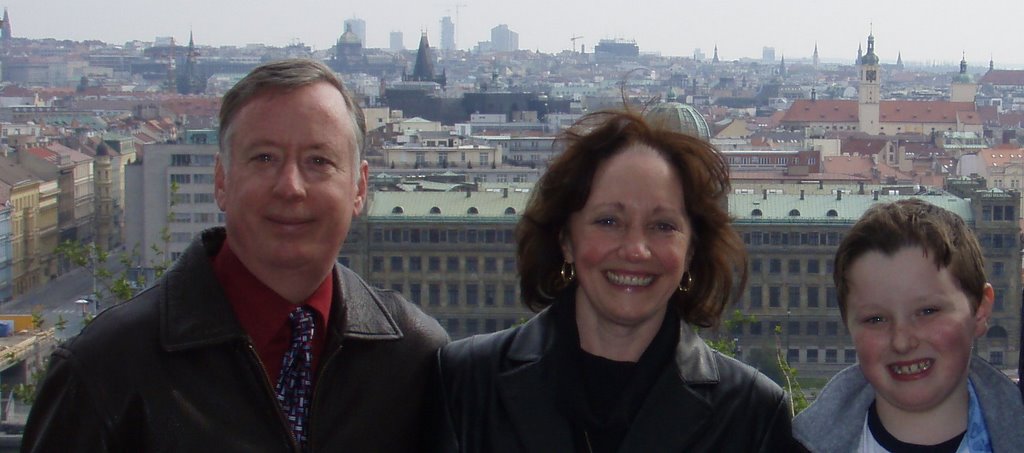
Here are Jiri, Julie, and Vera with the National Museum across the street as a backdrop. 
The only one missing is my DC employee, Abdul, who left the company a few weeks ago.
Even though I have only been here a bit less than two years I find myself getting emotional about leaving. The department has changed a lot since I got here - for the better I think - and the credit goes to the staff who works for me. I will miss them.
Thursday, June 12, 2008
The Goodbyes start...


Tuesday, April 22, 2008
"Does Radio Free Europe Still Exist?"...
Here is an op-ed from today's Washington post that makes a good case not only for our continued existence but for our resurgence. Since coming here in 2006 I have said that most people under the age of 45, when you mention Radio Free Europe, think of the r.e.m. song. It's time for Congress to put up or shut up. Those of you who visit the blog know that I report on the falling dollar every month, because I am greatly impacted since I am paid in dollars but most of my expenses are in Euros or Czech crowns. The same is true for RFE/RL - our entire budget from Congress comes to us in dollars and the dollar has fallen so much recently that operations may be impacted.
Radio To Stay Tuned To
By Anne Applebaum
Tuesday, April 22, 2008; A19
"Radio Free Europe? Does that still exist?"
That was the question; the speaker was an Important Public Broadcaster, visiting Europe for a few days last week. It wasn't a surprising query, as these things go, or an ignorant one. Not many other Americans know that Radio Free Europe still exists, so why should he?
Nevertheless, the query bothered me, because Radio Free Europe -- the Cold War news service that was, for decades, the only source of independent information in Eastern Europe -- does exist. In fact, it's as important as it ever was, at least in the 21 countries and 28 languages in which it is still often the only source of independent information: Farsi for Iran, Arabic for Iraq, Dari and Pashto for Afghanistan, plus Turkmen, Azeri, Belarusan, Georgian, Chechen, Tajik, Albanian, Serbian and Russian, among others. The fact that you haven't heard anyone mention RFE lately, let alone the achievements of its Afghan journalists-- they provide much of the news in much of that country -- says more about the poverty of the American foreign policy debate in general (and this election-year debate in particular) than about almost anything else. In RFE, we have an American institution that is admired, even beloved, in many difficult parts of the world; and yet we are slowly, methodically, starving it to death.
Reputation to the contrary, RFE is not American propaganda radio. It is better described as "surrogate radio": a broadcasting service that supplies local, national and international news, in radio, Internet and sometimes video form, in countries where other local news is weak or unavailable. Most of the programming is written by local journalists, who follow local politics in the local languages. Many of them live in the countries they cover, sometimes at great risk. When the Newseum was opened in Washington last week, the names of four RFE journalists -- a Turkmen, two Iraqis and an Uzbek -- all killed in the past two years, were already inscribed on a plaque there. In the past year alone, RFE has dealt with staff kidnappings in Iraq and Afghanistan, disappearances in Turkmenistan, official harassment in Russia and Belarus, and blackmail from Iran.
Occasionally, RFE journalists even have to be smuggled out of their home countries. But when this happens, they wind up in Prague, where, for anachronistic post-Cold War-era reasons (President Vaclav Havel gave RFE a building there after 1989) the organization now has its headquarters. Once there, they can't go home, they can't get green cards, they don't speak Czech, and, now that the dollar has collapsed to a degree not fully appreciated in Washington, they can't support themselves, either. RFE, which at its peak received $230 million annually in congressional funding, now gets $75 million in rapidly devaluing currency. That money pays for transmitters, salaries, security and anti-jamming technology as well as programming and Web content in 28 languages. To put that in perspective, as RFE President Jeff Gedmin likes to say, $75 million is also the price of four Apache helicopters.
Which is an apt comparison, since, if RFE vanishes, we may need a lot more helicopters to replace it. Many analysts -- our defense secretary among them -- pay much lip service nowadays to the need for "soft power," the non-military initiatives and institutions that, once upon a time, helped us win hearts and minds in remote places, even when we wouldn't or couldn't send an army. Each of the presidential candidates has implicitly agreed, claiming that when he or she is elected, foreign policy is going to be conducted differently, more diplomatically and so on. But what does that entail? Will "diplomacy" mean we force Slovenia and Norway to send a dozen more soldiers to Afghanistan? Or should diplomacy" mean that we help the people who are trying to foster civilized public debate in Afghanistan as an alternative to warfare? When I was at the RFE office in Prague several weeks ago, the Afghans there showed me the enormous, old-fashioned canvas mailbags that arrive every week from Afghanistan, full of letters thanking the presenters, offering arguments, making comments -- and asking why there isn't more service, more coverage, more than 12 hours of daily service from Radio Free Afghanistan.
RFE does have a good number of admirers in Washington, as well as a few constructive critics, usually people who wish it did more things better. What it does not have, however, is an advocate: someone, in Congress, the White House or on the campaign trail who remembers that Americans have done soft power rather well in the past, that the collapse of the dollar is more than a minor irritant for rich tourists, that with better transmitters we could reach more Iranians, and that we could easily swap a few helicopters for better-informed Afghans. "Yes" is the answer to the Important Public Broadcaster's question; Radio Free Europe still exists. But if no one remembers to support it, politically and financially, Radio Free Europe won't exist much longer.
Wednesday, April 9, 2008
The new Radio Free Europe building...
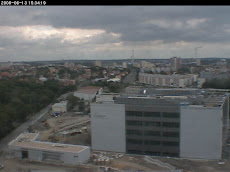
I made a visit to the new building today, after about two months since I was last there. There is much progress but also much work to be done. Our technical guys will get in soon to start
Here is the building juxtaposed against the artist's concept on a billboard.
This is the view from inside the building looking up to the top of the atrium. Of course, it will look a little better when all of the scaffolding is gone.
You have to use your imagination to visualize it, but this is my future office. This is where the future magic will happen.
Thursday, February 28, 2008
What will happen to the current Radio Free Europe building?...

The National Museum at the top of Wenceslas Square, with the Radio Free Europe building just visible on the left.
Well, my advice would be to knock it down and build a 5-star hotel on the site. The location, at the top of Wenceslas Square right next to the National Museum, makes it one of the most attractive in the city for tourists.
That's not the Czech government's plan, though. According to today's Prague Monitor the National Museum will take it over and
National Museum revamp seen completed by 2018
By ČTK / Published 28 February 2008
Prague, Feb 27 (CTK) - The historical building of the National Museum (NM) in Prague and its new premises in the nearby building of the former federal parliament [ed. That's us] should be fully functional in 2018 when the museum will mark the 200th anniversary of establishment, NM director Michal Lukes has told CTK.
The historical neo-Renaissance building of the National Museum in the upper part of Wenceslas Square in Prague's centre was built in 1885-90 and it has never been completely reconstructed since.
The national heritage building and the reconstructed federal parliament building from the early 1970s will be connected by an underground tunnel. The new premises will extend the museum's exhibition space by several thousand square metres.
The former federal parliament building now houses Radio Free Europe (RFE) that is to leave it by March 31, 2009 at the latest when its new seat further away from the centre is to be completed.
The decision to move RFE from the centre was made after the terrorist attacks on the United States in September 2001 for security reasons.
"We would be glad if it were possible to make the (museum) complex accessible right from the metro (underground)," Lukes said.
Together with the NM reconstruction the whole Wenceslas Square is to be revitalised and the city arterial road passing by the museum is to be relocated.
Lukes said the museum also prepares a reconstruction of its depository in Terezin, north Bohemia, where all stock and libraries from the historical NM building are to be moved in 2010.
The reconstruction is to cost 4.5 billion crowns. [ed. $272million]
I'm not sure about the tunnel idea, considering that probably the most used metro station in the city (linking the green and red lines) sits underground between the National Museum and our building. And if today they are saying it will be done by 2018, my money is on completion by 2025 (if ever). I hope I'm still around to witness the grand opening.
Friday, February 22, 2008
Another Congressional delegation visits RFE/RL yesterday...
The second of the week.
From the RFE/RL press release:
Senator John Kyl (R-Arizona), Congresswoman Jane Harman (D-California) and Congressman Elton Gallegly (R-California) -- spoke about U.S. goals and relations with Russia, the Middle East, Central Asia and other countries in RFE/RL's broadcast region during a roundtable today at RFE/RL's broadcast center in Prague.
Senator John Kyl (R-Arizona)
Congresswoman Jane Harman (D-California)
Congressman Gallegly (R-California)
Wednesday, February 20, 2008
Senator and Congressman visit RFE/RL...
Yesterday was the latest in a string of visits to RFE/RL by US politicians.
From yesterday's RFE/RL press release:
Congressman Alcee Hastings (D-Florida), Chairman of the U.S. Commission on Security and Cooperation in Europe (CSCE) and Co-Chairman Senator Ben Cardin (D-Maryland) today said recognition of Kosovo's declaration of independence on Sunday will bring to successful conclusion a difficult chapter in the break-up of former Yugoslavia. Both U.S. legislators said they hope to persuade other members of the Organization for Security and Cooperation in Europe (OSCE) to follow U.S. leadership in recognizing Kosovo.
Senator Ben Cardin (D-MD)
Congressman Alcee Hastings (D-FL)
Tuesday, February 5, 2008
New building...
I made a visit to the new RFE/RL building last week. I have visited many times before, but is the first time I have been able to go inside the building. Much progress is being made and there is still cautious optimism about a completion this summer as planned.
The number of workers both inside and outside of the building is amazing. It looks like organized chaos (at least I hope it's organized).
Here is the view from just inside the gate. Windows and exterior fascade are going on.
Here is a slightly closer view. The open area on the top floor will be a terrace (it will be used for eating outside in warm weather and all year around by the smokers).
Here is the view from my future office window.
Wednesday, January 16, 2008
Wall Street Journal article on RFE/RL...
A Voice for Freedom
U.S.-backed broadcasts remain the ultimate in "soft power."
by MATTHEW KAMINSKI
Saturday, December 29, 2007 12:01 a.m. EST
PRAGUE--Can radio change the world? It used to. On the walls at Radio Free Europe/Radio Liberty here hang pictures of Solidarity rallies in Poland and a smiling Vaclav Havel. The message isn't subtle, or inaccurate: This legendary U.S.-funded broadcaster helped win the Cold War.
The glory days are past at RFE/RL, and for American public diplomacy as a whole. After the fall of the Berlin Wall, when history ended and freedom triumphed (or so it seemed), Munich-based RFE/RL landed on the chopping block. It was saved, on a threadbare budget, partly thanks to then Czech President Havel. In gratitude, he offered cheaper digs in a communist-era eyesore here in Prague that previously housed the Czechoslovak Parliament. Yet in the public mind, the station founded in 1950 by the likes of George Kennan and John Foster Dulles might as well be gone.
"We're trying to revive it," says Jeffrey Gedmin, the broadcaster's new president. Doing that, and making the station a valued tool of U.S. foreign policy again, won't be easy.
The neoconservative expert on Germany, and longtime denizen of Washington's think-tank world, makes an energetic pitch. In his nine months in office, Mr. Gedmin has told anyone who'll listen that government-funded, robust "surrogate broadcasting"--a stand-in where the real thing is missing--matters as much as ever. "Massive evidence suggests that it irritates authoritarian regimes, inspires democrats, and creates greater space for civil society," he says.
The mission at RFE/RL, a pioneer in U.S. international public broadcasting, didn't end in 1989. It merely moved further east and south. (The Europe in its name is an anachronism; the original Central European stations were shuttered years ago.)
RFE/RL broadcasts in 28 languages to some of the highest-priority and most difficult countries for U.S. foreign policy today. It's the most popular station in Afghanistan (with a 67% market share in a country where radio is the main source of information), and one of the last free broadcast outlets in Russia, Central Asia and Belarus, and the American voice in Persian in Iran.
But there are several strikes against them. The first is the new "media rich" environment. With so much competition from the Internet, podcasts, widespread satellite television and radio--none of which existed in Cold War days--the surrogate stations, such as RFE/RL, Radio Free Asia or Radio Marti for Cuba, are struggling to hold on to listeners and influence, along with the rest of old media.
In addition, the "surrogates" suffer from an existential crisis of their own. The nine-person Broadcast Board of Governors, the federal agency responsible for all government-supported international stations, is bipartisan, but deeply politicized and with a reputation for micromanagement. Recent years saw the division blurred between surrogate (epitomized by RFE/RL's stations) and traditional public diplomacy broadcasting that had been the preserve of the Voice of America, which as the name suggests is tasked with explaining U.S. policies to the world.
The board experimented with different approaches, pushing a commercial radio model on the stations intended to win young listeners with music and playing down the old staple of serious programming about politics, the economy and culture. Old timers were aghast. "The war of ideas has been demoted to the battle of the bands," noted one participant at a McCormick Tribune Conference earlier this year on the future of U.S. international broadcasting.
The quality and professionalism of the stations have come under attack as well, most notably at Radio Farda, the Iranian service, until recently run jointly by RFE/RL and Voice of America. Alhurra, the television broadcaster to the Arabic-speaking world, got into political trouble earlier this year for airing interviews with terrorists. Its director resigned.
The final strike is structural. Government-run agencies tend to be bureaucratic and inertia-bound; in other words, wholly ill-suited for the fast-paced media world. Marc Ginsberg, an Arabic-speaking former U.S. ambassador, says "public diplomacy needs to evolve" and tap the best of America's private sector expertise in Hollywood or on Madison Avenue.
Mr. Ginsberg co-founded a nonprofit television production company, Layalina, which makes shows that are then sold to Arab-language networks in the Middle East. Its "On the Road in America," which followed four Arabs on a 10-week trip across the U.S., was one of the most popular shows in the Arab world this year.

Mr. Gedmin, 49, spent a chunk of his career at the American Enterprise Institute and then ran the Aspen Institute Berlin before taking his current job in Prague. He agrees with a lot of this criticism. Early on he shuffled personnel and pushed RFE/RL back toward its original "surrogate radio" role with the caveat, he says, that when appropriate, the stations shouldn't shy from trying to explain America to a world so rich with anti-Americanism.
"Our mission is news," he says. "It's not psy-ops, it's not U.S.-G [government] line, it's news. But we tell [local staff] two things. It has got to have a purpose--to be promoting democratic values and institutions. We also tell them to shoot straight. It's indispensable for credibility in our markets. The moment that any country like Iran thinks that we are a front for the Bush administration or for U.S. policy we will lose credibility."
He acknowledges some people in the U.S. won't like it. Aware of the political damage done by Alhurra to the reputation of U.S. international broadcasting, Mr. Gedmin quickly adds that anti-Americanism isn't tolerated and dares anyone to provide proof of it at his shop. But émigré-run stations are prone to factionalism and to broadcast what sometimes sounds strange to American ears.
"You've got to create space to let them find their own voice to talk to their own people," Mr. Gedmin says. "It is not my voice. My voice doesn't translate well into Persian."
Radio Farda is the priority fix. He wrested full control over the station from Voice of America upon taking office, and put in new Iranian management. Next he looked at the programming.
"The editorial content was very weak, and very underwhelming, and in some cases just downright misguided," Mr. Gedmin says. "When I came they thought, 'Oh my gosh, Washington, Bush, neocon.' All I did was I sat down with them day after day and said, 'What kind of groups do you want to reach inside Iran?' And they said, 'Labor, students, women--a political class open to political change.' And I said, 'Do we do that?' 'Not really,' they said. 'Ok, so what are the issues [they care about]?' I asked." The response: "Economy, corruption are very big. Human rights."
Radio Farda has moved to push these different kinds of stories more forcefully. Its news and commentary is now supposed to be geared at an elite audience.
There as elsewhere, the idea behind surrogate broadcasting is to inform as well as to start a conversation and encourage critical thinking inside those countries by injecting independent news and ideas unavailable in the local media. Mr. Gedmin cites the coverage of fuel rationing this summer in Iran, which the state-run broadcasters avoided.
"We sent reporters to gas stations who went up to people who said, 'I've been waiting for five hours in my car and this government is giving my money to Hezbollah. I'm furious.' We put it on the Web site, we put it on the radio. We had about three hundred calls."
Mehdi Khalaji, a former Farda staffer now at the Washington Institute for Near East Policy who put out a critical report about the station just before Mr. Gedmin took over, says quality control and training remain a problem. "[Mr. Gedmin] needs to hire impartial journalists to monitor Radio Farda," he says. Mr. Gedmin says attracting top journalists to Prague, and on contracts paid in the sinking U.S. dollar, is a challenge. But he says the station is now on the right track.
Most of the region covered by Prague-based stations is on the wrong track, marked by rising authoritarianism (and anti-Americanism), particularly in Russia. Prague has, reprising the role played by Munich, become one meeting point for people interested in championing the free press and democracy in Russia, the Caucasus, Iran and Central Asia.
In October, the station marked the one year anniversary of the assassination of Russia's best-known journalist, Anna Politkovskaya, with a large conference. A small research team, though a shadow of its Cold War self, looks at media and political trends in its new region. It's probably too small. The McCormick Tribune report notes "substantial analytical research capability" is a "prerequisite for fully effective 'surrogate' broadcasting."
Mr. Gedmin says the radio needs to push further into cell phone texting, podcasts and other new technology to deliver its programming. He hired a new editor for its dowdy Internet site.
With the crackdown on independent voices in Vladimir Putin's Russia, the Russian-language Radio Liberty will have to find new ways to broadcast radio, television and written news and analysis into the country through the Web. "The Russians are kicking us off the air," Mr. Gedmin says. "Pretty soon we're going to have to go to an Internet strategy. If we get it right, it could be the refuge for liberal thought in Russia."
It's effect is hard to gauge and a source of dispute--in the target countries and in budget battles on Capitol Hill. Radio Farda is listened to by about 13.5% of the radio audience, according to telephone surveys. For all 28 services, the average is 10%. "We care about audience size," Mr. Gedmin says. "Never misunderstand me. But you can't measure our success by audience size alone."
As far as its importance goes, Mr. Gedmin cites all the efforts made by governments to jam the radio signal, block the Web site and publicly denounce RFE/RL. Its journalists, as others in repressive countries, take considerable risks to do their jobs. This year, two RFE/RL reporters have been killed and one kidnapped (and freed after two weeks) in Iraq, two went missing for several weeks in Turkmenistan, two fled Russia, one was detained in Iran for eight months, and two Afghans were threatened with beheading by the Taliban and one kidnapped.
A 26-year-old reporter for the Uzbek service was shot and killed in October in front of his office in Kyrgyzstan. He had told colleagues in Prague that he had been followed by Uzbek security.
Skeptics notice the early changes. "Jeff's the best thing to happen to RFE/RL in a decade," says Enders Wimbush, a vocal critic who headed Radio Liberty in 1987-93 and currently works at Washington's Hudson Institute.
Yet the outcome of Mr. Gedmin's battle to convince Congress that American taxpayers ought to pick up more of the tab won't be known for a while. Its budget, at $77 million this year, is down from $230 million in 1995, when the U.S. cashed the "peace dividend." None of Mr. Gedmin's successors managed to get Capitol Hill to commit any new resources in 12 years.
How to put American public diplomacy in support of democracy back in high gear is an immediate challenge, no matter who ends up living in the White House. Mr. Gedmin wants to get international surrogate broadcasters back into the discussion. "At a time when everybody is arguing 'soft power' is so important, this kind of broadcast is the ultimate in soft power," he says. "It costs peanuts. And it has a measurable impact of success."
Mr. Kaminski is editorial page editor of The Wall Street Journal Europe.
Wednesday, January 9, 2008
Senators at RFE/RL...
We had four Republican US senators visit our Prague headquarters this afternoon. The distinguished visitors were Senator Mel Martinez (R-FL), Senator John Thune (R-SD), Senator Charles Grassley (R-IA) and Senator Larry Craig (R-ID).
They met with our president, Jeff Gedmin, visited the offices of Radio Free Afghanistan and then each participated in interviews with our central news group as well as Radio Free Iraq and radio Free Afghanistan.
Senator John Thune (R-SD)
Senator Mel Martinez (R-FL)
Senator Charles Grassley (R-IA)
Senator Larry Craig (R-ID)
Senator Craig is recently famous for his arrest at Minneapolis/St. Paul airport for lewd conduct, later pleading guilty to a lesser offense. From Wikipedia:
Larry Edwin Craig (born July 20, 1945) is an American politician from the state of Idaho. As a Republican, he has represented the state of Idaho in the United States Senate since 1991. In addition, Craig served in the U.S. House of Representatives, representing Idaho's 1st congressional district (1981–1991).[2] Including his service in the House of Representatives, Craig is the second-longest serving member of the United States Congress in Idaho history, trailing only William Edgar Borah. In addition to serving in Congress, Craig has been a member of the Board of Directors of the National Rifle Association since 1983.[3] Craig has also been selected for induction into the Idaho Hall of Fame.[4] Although he was selected in March 2007, the announcement was made in October 2007.[5]
On August 27, 2007 the Capitol Hill newspaper Roll Call revealed that Craig had been arrested for lewd conduct in a men's bathroom on June 11, 2007, and pleaded guilty to a lesser charge of disorderly conduct on August 8, 2007.[6] As a result of the controversy surrounding his arrest and subsequent guilty plea, Senator Craig announced his intention to resign from the Senate at a news conference on September 1, 2007, which was to become effective on September 30, 2007. After failing to withdraw his guilty plea, on October 4, 2007, Craig released a statement refusing to resign as Senator for Idaho. Craig has stated that he will not run for re-election in 2008.[7]
Friday, December 14, 2007
The new Radio Free Europe building...
The building is still coming along nicely - and is still on schedule. There was a topping off ceremony two weeks ago, so the building is as high as it's going to get. At the construction site there was food, refreshments, a band and speeches.
We should be able to get into the building in March to install the network equipment. In June we should be able to install some studios and then in early August we should be able to start moving broadcasters. In the best case scenario everyone will be moved by the end of December. More likely, though, is everyone moved by the end of February 2009.
Time is going by very fast and my work on buying things needed in the new building is heating up. The network equipment I mentioned was ordered last week - at a cost of over $2M. New studio equipment will be ordered soon - for more than $1M. Studio furniture, racks for the computer equipment, an in-house monitoring system ,etc., etc. It's getting busy, but this is the fun part.

Monday, November 5, 2007
A happy ending to a Radio Free Europe employee kidnapping...
At last a happy ending to a work related hostage situation. Here is the story from National Review's website (www.nationalreview.com):
A hostage situation with a positive outcome [Tom Gross]
A reporter for the U.S. Congress-funded Radio Free Iraq has today been released after a brutal 10 day kidnapping ordeal in Baghdad which, for security reasons, was kept out of the media.
Secretary of Defense Robert Gates was personally involved in the process that led to her release, as well as officials from the Iraqi government and armed forces.
Jumana Al-Obaidi, age 29, had been kidnapped by a criminal gang that initially said it was a Shia militia and then switched to call itself the “Sunni fighters for freedom.” Their real identity is not yet known.
Al-Obaidi, a non-practicing Sunni, was severely beaten during her kidnapping sustaining among other things two black eyes, and is presently on her way to see a medical team. Her driver was executed by her abductors at the time of her kidnapping.
Radio Free Iraq is part of the Prague-based Radio Free Europe/Radio Liberty (RFE/RL), which despite its name, today focuses on doing very important work broadcasting in Arabic, Persian, Pashto and 25 other languages to the peoples of Iraq, Iran, Afghanistan and elsewhere. (The network has also branched out from radio into television and internet.)
Two other RFE/RL correspondents in Baghdad (mother-of-three Khamail Khalaf, and a young man, Nazar Al-Radh) have already been murdered this year.
The remaining seven Baghdad bureau staff have been offered relocation but all have refused saying they are determined not to give in to the terrorists and to continue reporting fully and frankly what is happening in Iraq to other Iraqis. The station has a wide audience in Iraq.
A correspondent on the Uzbek language service of RFE/RL was murdered last week, almost certainly by the Uzbek security services. And last year, a 58-year-old female correspondent for the RFE/RL Turkmen service, Ogulsapar Muradova, was found dead in prison.
Thursday, October 18, 2007
Jeff Gedmin on CNN tomorrow...

An interview with our company president, Dr. Jeff Gedmin, will be broadcast on the CNN show "International Correspondents" tomorrow (Friday). It is on at 7:30 PM in Minnesota.
Sunday, October 14, 2007
Pigeon attack...
I was sitting at my desk last week when I heard a loud thud. I turned around but there was nothing unusual out my window, which if you recall looks onto a courtyard. I assumed that there were workers on the roof above my office and thought nothing more of it.
The next day I entered my office and as I walked around the desk to get to my chair I noticed something on the window. It looked like this. Look VERY closely.
Still can't tell what it is? Here is a view of my window from across the courtyard.
Yep, it was a pigeon strike. You can't tell from the picture, but the impression left on my window has the detail of an x-ray, showing individual feathers and details of the beak. It obviously wasn't even slowing down when it hit the window. I assume it has shuffled of the mortal coil, is not pining for the fjords and that it is an ex-pigeon.
Monday, October 8, 2007
More YouTube Radio Free Europe video...
I found another video on YouTube that talks about RFE/RL. It says that it's a movie trailer but when I googled it I didn't find anything, so I'm not sure if this video is a piece of something bigger or not. Stoll, there's some good stuff here, including video of the effects of the bombing of the RFE building in Munich in 1981.
Monday, October 1, 2007
Happy New (Fiscal) Year...

Well, today is October 1st, the first day of RFE/RL's new fiscal year. Our fiscal year is in synch with the FY of the US government, which makes sense since we get 100% of the money we spend from Congress. I started work in mid-August last year, so the end of that fiscal year was pretty much a blur. I hadn't been there to prepare for it, and I was so involved in just figuring out what my job was that I don't think I did much good (or bad) as it ended.
Like the government and other entities that it funds, money from a current fiscal year has to be spent by the end of that fiscal year or you lose it. I won't get into the nuts and bolts too much, but by "spent" I don't mean that things have to be paid for, but there has to be either an order placed by September 30th or you have to have received the goods or services by September 30th. There is absolutely no incentive to spend a penny less than your budget, even if you spend money on things you don't really need. If you don't spend your full budget this year, the perception (and maybe the reality) is that you don't need as much money as last year (and we can't have that).
Congress being as efficient as they are (do I need to use the //sarcassm// warning?) we won't actually get a new budget passed and signed by the President until January or February. What do we do until then? There is something called a continuing resolution. Congress basically allows the US government (and grantees like RFE/RL) to continue to operate at last year's funding level until they get around to passing a real budget. But if the real budget comes in lower than last year, you are in a pickle because you have been spending as if you would get the same amount as the previous year.
There is a huge difference between the end of the fiscal year at RFE/RL (a non-profit grantee of the US government) and a company like ATK (my last employer). On the private side there are so many more factors in play that the complexity and work involved can be enormous. Take how much you spend in the year. At RFE/RL what we spend is equal to the budget that Congress gives us. When the budget is passed we get the full amount dropped on us at one time (albeit a little later than the actual start of the fiscal year). A private company has to actually 1) sell things, 2) deliver things, 3) invoice for the things that it delivered, and then 4) get paid. If you sell less than you projected you will take in less cash than you projected. Even if you are right about how much you sell, if you deliver later than planned it means that some of the money you thought you would get paid this year will actually be paid next year. Then there's the whole profit thing. The price of steel (or aluminum or tungsten) goes up unexpectedly and all of the sudden you are selling items at a loss. Of course, the price of steel could go down, except that isn't likely. Prices rarely go down.
The other big difference between a non-profit, government funded company like RFE/RL and a company like ATK is stockholders. How much cash, sales and profit you estimate to generate this year is noted by the Wall Street analysts and these figures are then used to gauge how well you are running your company. If you come in at or very close to expectations the company management proves that it knows what it is doing. Coming in with better than expected numbers is good too. But come in under expectations and Wall Street will assume you don't know what you are doing and the result is that the stock will get pounded.
I'm not complaining about this system since it has worked very well over these many years. But these additional influences make for a busier end of the fiscal year, with greater pressures and frustrations, but also greater rewards. A stock price is a solid way to gauge how well you are (collectively) doing your job. There is no similar way to gauge effectiveness when you work for a government funded non-profit.
Thursday, September 27, 2007
The new RFE/RL building...
I have added a picture on the left that shows our new office building being constructed. I will try to update each week to show the progress. I hope it gets completed on time.
Friday, September 21, 2007
Our new Radio Free Europe building...
The groundbreaking for our new office buiding was last October 13th, but real construction did not begin until this spring. Here is where things are at so far. They are on the second of what will be five floors. They say that they will be topped out and enclosed in November, so that the serious work on the interior can start right about the time the cold weather hits. I hope they are right. The schedule calls for us to get in for some preliminary work next May and to take possession in August. I will update every once in a while. 
Here is what it will look like when it is finished.
Wednesday, September 19, 2007
President Gedmin's Op-Ed in today's Washington Post...

Recently, Iran has been arresting or otherwise harassing Iranian-Americans, including some who work for Radio Free Europe/Radio Liberty. One of our correspondents, Parnaz Azima, had her passport taken from her and became a virtual prisoner when she visited Iran in January to see her ailing 94 year-old mother Just yesterday she was finally allowed to leave Iran and was reunited with family, friends and RFE/RL colleagues today in the US.
Our president, Dr. Jeff Gedmin, has an op-ed piece in today's Washington Post.
Voices That Tehran Fears (Washington Post, September 19, 2007) by Jeffrey Gedmin
Our reporter Parnaz Azima finally made it out of Iran yesterday. Iranian
authorities, who had blocked her exit from the country since January,
returned her passport two weeks ago but then proceeded to create a series
of bureaucratic obstacles that prevented her from returning to her family
and colleagues. Azima, who has U.S. and Iranian dual citizenship, works
for Radio Farda, the Persian-language broadcast service of Radio Free
Europe/Radio Liberty, the congressionally funded broadcasters based in
Prague.
Azima is one of Iran’s best-known literary translators. She is famous for
her translations of Ernest Hemingway’s works. In January she traveled to
Tehran to visit her ailing 94-year-old mother and unwittingly became
ensnared in a larger game being played by Iran’s regime. Its aim is simple:
to intimidate dissidents at home while pressuring the United States to
refrain from supporting Iranian civil society.
Consider the way Tehran is attempting to put Radio Farda (“Farda” means
tomorrow in Persian) in a bind. The Iranian government calls Farda a
“counterrevolutionary radio station.” In fact, Farda simply provides the
Iranian people the news their government denies them. Our ratings remain
high. The regime expends considerable effort trying to jam our signals and
block access to our Web site. It’s not hard to understand why.
This summer Farda provided in-depth reporting on Iranian protests over
the regime’s gas-rationing policies. Farda relied on stringers around the
country for dozens of interviews with experts, officials and ordinary
citizens. We provided first-rate, objective analysis from economists
outside Iran. While there had been some opening in the media landscape
under reformist president Mohammad Khatami, this process of liberalization
was shut down by Mahmoud Ahmadinejad after he became president in 2005.
Today, government censors tell editors how they may cover “sensitive”
stories. One may, for example, report on Iran’s debate with the world
community over Tehran’s nuclear program. One may not, however, use the word
“bomb” or the words “United Nations Security Council.” Not surprisingly,
news-hungry Iranians turn to Farda and Voice of America for accurate news
and information.
Recently, Farda covered the arrests of members of Tehran’s bus drivers
union. Our broadcasters reported on the expulsion of Baha’i students from
Iranian universities. This summer we analyzed the crackdown on women’s
dress code violations. Last week we featured a sad, bizarre story on “dog
prisons” in Iran (clerical rulers view pet dogs as out of step with Islam);
some police officers are apparently chafing under pressure to arrest kids
walking their pets in parks. These social fissures are important. In a free
society, independent media would feel obliged to cover them.
Our broadcasters and correspondents are brave to do what they do.
Intelligence officers in Tehran interrogate and threaten family members of
Farda staffers. This summer, a young journalist working for us was
summoned by an Iranian court to return home to face charges of conducting
“activities against national security.” Authorities have threatened to take
possession of his aunt’s house (in exchange for “bail” he “owes”) should he
not appear for trial. Another colleague expressed concern to me about
activities of the Iranian Embassy in Prague. In the 1980s and early 1990s,
the Iranian regime moved hard against exiles, killing Iranian citizens in
numerous European countries. Iran’s foreign minister, when he was
ambassador to Turkey in the late 1980s, was expelled when it was
discovered that he was involved in nabbing Iranian dissidents. Such
activities, unfortunately, do not seem to have stopped; Iranian authorities
have discouraged Parnaz Azima from returning to Farda.
In this context, it can be disheartening to witness the endless bickering
in Washington over how to help Iranian civil society. It is strange to hear
the outcry from some who rail against the U.S. government’s earmark of $75
million to aid the effort. That seems a paltry sum considering the
importance and enormousness of the task at hand. Does the regime use this
modest support as a pretext to crack down on dissidents? Of course it does.
That’s what dictators do. All of us are still waiting for those flawless
and risk-free alternatives.
Our Farda team is hardly a monolith. Our roughly three dozen colleagues
include social democrats, monarchists, passionate pro-Americans and ardent
critics of the U.S. president and his policies. Our youngest employee is
23, the oldest 73. One thing unites this diverse group: the conviction that
Iran deserves a decent, accountable government and a political system far
freer and more tolerant than the current one. For some that sounds like the
dirty words “regime change.” That’s a pity. I thought we all liked “soft
power,” especially after Iraq. Many of us think this work still represents
America at its best.
The writer is president of Radio Free Europe/Radio Liberty.
Note: Jeff has been our president only since April, and in that short time has accomplished a great deal. He is a brilliant thinker and analyst, and I find him to be an extremely likable guy (and he's not above having a beer with the guys at Jama's, which counts for a lot in my book).
Thursday, August 30, 2007
Radio Free Europe on PBS...

The PBS show Think Tank with Ben Wattenberg is focusing on RFE/RL in a broadcast that airs in some locations this weekend. I wasn't able to find it on the TPT channels in the Twin Cities, so you might have to wait until later to catch it. I hear that we will get DVDs of the broadcast and if we do I will report on the show after I see it.
Monday, June 11, 2007
Meeting the chairman...

There are VIPs in Prague this week. The June meeting of the Broadcasting Board of Governors (BBG) is being held here. The BBG overseas RFE/RL and the other "entities" such as Voice of America (VOA), Alhurra, Radio Sawa, Radio Farda, Radio Free Asia (RFA), and Radio and TV Martí. The BBG has a new chairman, Jim Glassman (at right), who was just confirmed last Friday and is replacing the outgoing controversial chairman Ken Tomlinson. I talked to Glassman for a few minutes after a meeting today at the Don Giovanni hotel, next to the site of our new new building. He is very bright, but comes across as a normal guy who you could discuss sports or politics with over a beer. Here is part of his bio from the web site leadingauthorities.com.
James K. Glassman is a resident fellow at the American Enterprise Institute, a Washington public policy think tank, where he specializes in issues involving economics and financial markets. In addition, he is host and co-founder of TechCentralStation.com, a website started in February 2000 that concentrates on matters of technology and public policy. He is also chairman of Investors Action, a new organization that aims to help educate and represent America's 100 million investors.
In November 2004, Mr. Glassman started writing a monthly column on investing for Kiplinger's Personal Finance magazine. He also writes a weekly op-ed column on political and economic issues for the Scripps Howard News Service.
Between July 1993 and July 2004, he wrote a syndicated weekly column on investing for The Washington Post, which also appeared in the International Herald Tribune and other publications. He has also been investing columnist for Reader's Digest.
Mr. Glassman's most recent book, The Secret Code of the Superior Investor (Crown) named one of the top 10 investing books of 2002 by Barrons.
From 1987 to 1993, he was editor and part-owner of Roll Call, the twice-weekly newspaper that covers Congress. Prior to that, he had a long career in magazine publishing -- as president of the Atlantic Monthly, executive vice president of U.S.News & World Report and publisher of the New Republic. In 1972, he started Figaro, a New Orleans weekly newspaper, selling it in 1979. He was executive editor of the Washingtonian magazine from 1979 to 1981. He has also had extensive television experience, as host of Capital Gang Sunday on CNN and TechnoPolitics on PBS. He has appeared as a guest on the CNN's Larry King Show, ABC's Nightline, PBS's Charlie Rose Show and many others. His articles have been published in the New York Times, Los Angeles Times, Forbes, Reader's Digest, and other publications.
However he is not without controversy. In the late 1990s he predicted the Dow would soar to 36,000 when it was only about 10,000 at the time. From Wikipedia:
Glassman is known for his market analyses and commentary on economics and equities investing. He is a long-term optimist and is quick to point out positive developments, which is clearly typified in his book Dow 36,000. In this book, published near the peak of the late 1990s stock market bubble, Glassman infamously declared that the Dow Jones Industrial Average was undervalued and would rise to 36,000. This prediction proved to be drastically off the mark.[1] In its introduction, Glassman and his co-author wrote that the book "will convince you of the single most important fact about stocks at the dawn of the twenty-first century: They are cheap....If you are worried about missing the market's big move upward, you will discover that it is not too late. Stocks are now in the midst of a one-time-only rise to much higher ground–to the neighborhood of 36,000 on the Dow Jones industrial average."[2]